Advisory Services

Screened before the capital arrives. 1,198 companies, one standard.

Capital advisory and structuring for companies in Argentina, Chile, and Uruguay raising foreign capital, and for the capital providers evaluating them. The rest of Latin America by direct mandate.

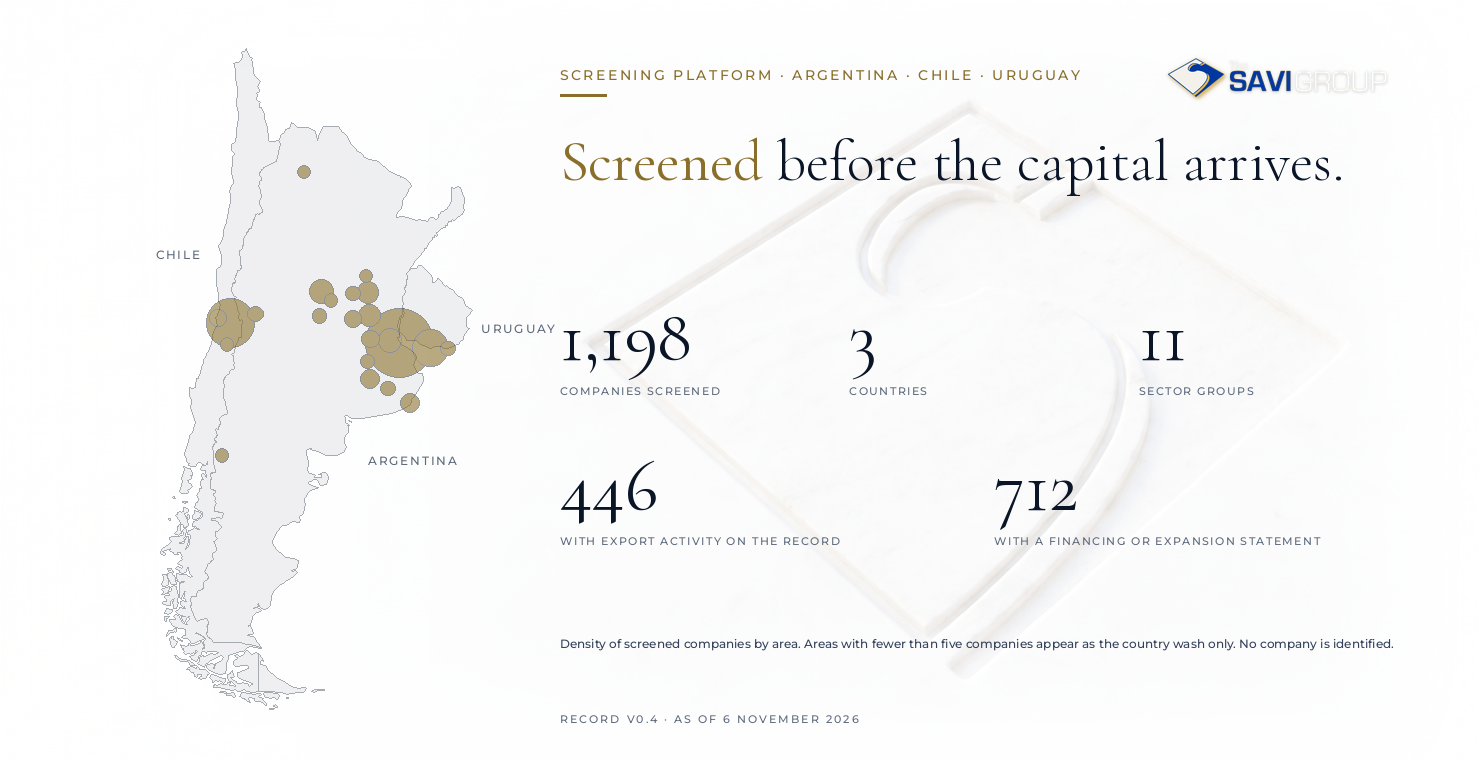
Density map of 1,198 screened companies across Argentina, Chile and Uruguay, with five figures: 1,198 companies screened, 3 countries, 11 sector groups, 446 with export activity on the record, 712 with a financing or expansion statement. Areas with fewer than five companies are shown as the country wash only; no company is identified.
The firm's screening record, version 0.4 as of 6 November 2026. No company is identified.

The origination is done before the mandate begins: 1,198 companies in Argentina, Chile, and Uruguay, screened to one standard.

Most foreign capital enters the Southern Cone through introductions, and introductions favor the companies that already know where capital sits. The firm's screening record reverses that sequence. It holds 1,198 private companies in Argentina, Chile, and Uruguay, each on one standardized sheet. The sheet records the business and its scale, the route under the local investment regime (RIMI, RIIR, and RIGI in Argentina, Pro Pyme in Chile, COMAP in Uruguay), export activity, and the capital its founders intend to raise.

Of the 1,198, 712 have stated a financing, expansion, or investment need, and 446 export today. For a capital provider, that is a sourced pipeline before the first trip. For a company, it is the standard it will be measured against, applied before any investor opens the file.

→

One standardized sheet per company

→

An evidence label on every fact

→

The route under the local investment regime

→

Export activity as recorded

→

The founder's stated capital and growth plans

→

Open questions and sources

The file an investment committee approves, prepared before the first meeting.

Foreign capital is allocated by committees that read before they meet. A committee weighs a company on its information memorandum, its financial model, and its data room, in the form and register it reviews every week, and it holds a Southern Cone company to the same form. The firm prepares that file, as it does today on institutional mandates in North America.

The engagement is scoped to where the company stands. An early conversation calls for a blind teaser and an executive summary. A live process calls for a financial model built from source data, or an independent review of the company's own, with sensitivity and downside cases, and for a data room indexed to the questions institutional investors ask. It closes with a schedule of the capital providers whose mandates fit the company and its regime route.

Adopting The SAVI Capital Model is the company's option, not a condition of the engagement. Where it is chosen, the firm drafts the terms.

→

Blind teaser and executive summary

→

Information memorandum

→

Financial model build or independent review, with sensitivity and downside analysis

→

Data room architecture and diligence response

→

Investor target schedule and outreach brief

→

Regime route under RIMI, RIIR, RIGI, Pro Pyme or COMAP

→

Model terms for companies that adopt them

A counterpart on the investor's side of the table, with a local's knowledge of the company's market.

A development finance institution, a family office, a search fund, a regional manager, or a strategic investor enters these markets with a counterpart who knows them from the inside, or not at all. The firm is that counterpart for capital of any origin. It screens the record and the market against the provider's mandate, delivers company sheets under confidentiality, and writes the regime route and the structuring memo. It maps the counterparties a transaction depends on and conducts local diligence, in English and Spanish, from Fort Lauderdale and Buenos Aires.

The firm stays on the file after closing where the mandate calls for it, with on-the-ground representation. Where a company has chosen The SAVI Capital Model, the firm also verifies its terms each year: the half of net profit distributed to the people who work there and the pay ceiling, documented in an evidence pack and attested by an independent accountant. In Chile, work for a capital provider is delivered through registered local partners where the law requires it.

→

A screened company set against a stated mandate (aggregate first; sheets under confidentiality)

→

Counterparty map and local diligence report

→

Regime path and structuring memo

→

On-the-ground representation

→

Model terms and post-closing verification

A written mandate, agreed with each client.

Each mandate is set out in a written proposal and an engagement letter with The SAVI Group: scope, deliverables, timeline, and terms, agreed directly with the client and disclosed to no one else. The firm delivers against agreed milestones and treats every company file as confidential from the first conversation.

The firm advises. It does not place securities, does not solicit investors into any offering, and does not recommend investments. Its work product is the information, analysis, and structure on which a client decides with its own advisers. Where a transaction reaches United States investors or falls under United States securities laws, a licensed intermediary carries the placement.

The practice begins in Argentina, Chile, and Uruguay, where the record is. Mandates elsewhere in Latin America and in Central America are accepted on direct request and scoped individually.

→

Since 2002

→

Fort Lauderdale and Buenos Aires

→

English and Spanish

→

Argentina, Chile, and Uruguay; the rest of Latin America by direct mandate

→

Regimes: RIMI, RIIR, RIGI, Pro Pyme, COMAP

→

Five white papers and more than thirty signed essays

The written view behind the practice.

Five white papers set out The SAVI Capital Model, its deployment under Argentina's investment regimes, and the case for origination in the Southern Cone. The essays on the Argentine economy are the firm's published reading of the country where most of the record sits.

Six questions, answered.

Who retains the firm?
Companies in Argentina, Chile, and Uruguay that are raising foreign capital, and the capital providers evaluating companies or sponsors in the region. Funds and research firms retain the firm for a practitioner's reading of the Southern Cone.
Does the firm place securities or solicit investors?
No. The firm prepares the company and the capital provider. Its work product is information, analysis, and structuring, and the decision to invest rests with the client and its own advisers. Where a transaction reaches United States investors or falls under United States securities laws, a licensed intermediary carries the placement. This page solicits no one into any offering.
Can a capital provider see the companies on the record?
The aggregate figures are public. A company's sheet is shared under a confidentiality agreement and with the company's consent, and no company is named on this site.
Is the record a rating of the companies?
No. It is the firm's screening record, built from public sources to a written standard. Each fact states its source, and nothing on it is a recommendation.
Where does the firm work?
Argentina, Chile, and Uruguay first, and the rest of Latin America and Central America by direct mandate, from Fort Lauderdale and Buenos Aires, in English and Spanish. In Chile, through registered local partners where the law requires it.
How does a conversation begin?
With an introductory conversation under a mutual confidentiality agreement, then a written proposal and an engagement letter with The SAVI Group. Terms are agreed with each client directly. Use the inquiry form and select Advisory Services.

Describe what you are raising, structuring or evaluating, and where it stands. The introductory conversation is held under a mutual confidentiality agreement.

The SAVI Group's advisory services are professional services contracted in writing with each client. This page is not an offer to sell, or a solicitation of an offer to buy, any security or any interest in any fund, and the firm does not solicit investors into any offering through it. The figures describe a screening record built from public sources, not a certificate on any company, and no company is identified here. Information about a company is shared only under a confidentiality agreement and with the company's consent. The firm's work product is information, analysis, and structuring prepared to its client's mandate; it does not recommend any investment, does not represent any government before United States authorities, and clients decide with their own advisers. Nothing on this page is investment, legal, or tax advice.